

Curtain Fabric Sample Binder Premium · Customizable · Professional Presentation A curtain fabric sample…
-
0 Comments
It’s Not That You Need a Binder — It’s That the Scene Does
Product Series · Part Ⅱ of Ⅲ
Anna B Floral Binder · A Three-Part Series
It’s Not That You Need a Binder —
It’s That the Scene Does
Scene · Lifestyle · The Relationship Between People and Objects
○ Part One · Material & Craft →
● Part Two · Scene & Lifestyle →
○ Part Three · Design & Aesthetics
The Same Binder, Many Different Stories
Part One covered materials and construction — the product’s skeleton. In Part Two, we add the flesh: what role does this binder play as it enters your actual life, across the different situations where you reach for it?
Before we dive in, I want to address a common misconception.
Most people’s buying process goes like this: “I need a binder” → search → find one that looks nice → buy. It seems logical. But there’s a flaw — you’re not actually buying “a binder.” You’re buying a specific way of organising and recording information. And different approaches suit entirely different life situations.
The more useful way to think about it: “In which specific moments do I need this kind of tool?” Context first, product second. Get that order right and what you choose will actually earn its place.
Below, we walk through four real-life scenarios and examine exactly what the Anna B Floral Binder brings to each of them.
Scene One: The Idea Catcher at the Coffee Shop
☕
Saturday Afternoon · Working Solo · Capturing Ideas
It’s two o’clock on a Saturday. You’ve brought your laptop to your regular café, ordered a latte, and settled in to work through a backlog. Somewhere in the middle of a document, something unrelated sparks in your head — a side project idea, a travel thought, a sentence you want to write down before it disappears.
What do you do?
Open a new file? Too formal — and switching windows breaks your flow. Grab your phone and type it in? Your fingers can’t keep pace with the thought, and a notification notification will hijack your attention mid-sentence. Instead: reach into your bag, open your binder, turn to a blank page, and write it down in a clean, steady hand. That single gesture is where ritual lives.
Anna B’s floral design adds warmth to that ritual. Set it on the café table beside your coffee and the scene composes itself naturally — unassuming, but quietly uplifting. A beautiful tool isn’t decoration. It’s an emotional trigger. A notebook you love looking at is one you’ll open more willingly — and in creative work, that willingness is everything.
The ring-bound structure also offers a hidden advantage: you can pull out any page you’ve written on and file it somewhere else — a dedicated ideas binder, an archive, a project folder — keeping your current binder light and current. That kind of fluid, reorganisable record system is simply impossible in a bound notebook. Ring binders are built for it.
Ideas don’t give advance notice.
But you can keep something nearby
that’s always ready to catch them.
— On capturing ideas
Scene Two: The Composed Professional in the Meeting Room
📋
Monday Morning · Team Meeting · Personal Brand
Monday morning, department stand-up. You walk into the conference room holding a binder. That happens every day — but have you considered what your binder says about you before you’ve said a word?
Picture two versions. Version one: a scuffed black plastic binder with fraying edges, stuffed with wrinkled printouts. Version two: a binder with a refined floral cover, crisp pages, a clean click when opened. The rustle of pages turning with confidence.
These two images communicate very different things to everyone in the room. The second one says: someone who cares about the details of their tools probably cares about the quality of their work. That’s not vanity — it’s quiet, consistent personal branding. In an environment where everyone wears similar clothes and uses the same laptop model, the details are what distinguishes you.
And of course, the workplace demands more than aesthetics. Functionality matters just as much:
- Insert materials on the fly: A handout arrives mid-meeting — open the rings, slide it in, done in three seconds
- Reorder as priorities shift: Project sequences change — the ring structure lets you reorganise instantly
- Tab and section: With index dividers, one binder manages multiple projects, each immediately findable
- Swap out old content: Archived materials come out, current versions go in — the binder always reflects the present
One habit worth highlighting: many professionals fall into a “stuff in, never remove” pattern — the binder gets thicker and slower until finding anything is a chore. Ring binders naturally encourage the opposite. Because adding and removing is frictionless, you maintain the habit of doing it. The tool shapes the behaviour: easy to reorganise → you reorganise more often → your information stays clean and current. Tools shape habits.
Scene Three: The Maker’s Portfolio and Inspiration Archive
🎨
Crochet · Embroidery · Journaling · Colour Management
If you make things — crochet, embroidery, fabric work, art journaling — then colour management is a familiar challenge. Yarn codes, fabric swatches, finished-piece documentation… information scattered everywhere, tracking down a specific shade taking far longer than it should.
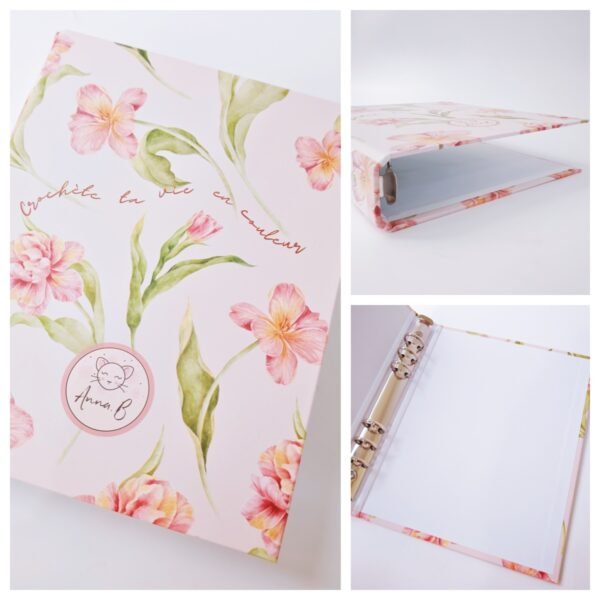
The Anna B Floral Binder is, at the conceptual level, built for exactly this. The French phrase on the cover — “Crochète ta vie en couleur” (“Weave your life in colour”) — says it plainly. This was never conceived as generic office stationery. It was made with the creative mindset from the very beginning.
For makers, the binder adapts fluidly to whatever the current project demands:
✦ How Makers Use the Binder
Colour reference → Clear pocket sleeves hold colour cards and yarn samples, sorted by palette — browse your colour library in seconds
Pattern library → Printed patterns from magazines or Pinterest, hole-punched and inserted — a curated personal archive
Project documentation → Each finished piece: a printed photo mounted on the page, notes on materials, time spent, reflections
Inspiration collage → Mix ruled, grid, blank, and kraft pages — build a rich visual and written record of the creative process
Materials checklist → List what each project needs; check it at the shop — nothing forgotten, nothing bought twice
It’s worth stressing why paper weight matters here specifically. Making involves gluing photos, mounting fabric swatches, sometimes even drawing directly on the page. Thin paper wrinkles under adhesive, curls at the edges, and tears when you turn it too many times. Anna B’s 100gsm+ pages hold steady — photos mount without puckering, ink doesn’t bleed, pages survive repeated handling. They can take what a maker puts them through.
And the ring structure means you can combine page types freely for each project: grid pages for charting stitch patterns, clear pockets for swatch samples, blank pages for sketching, ruled pages for notes. One binder, infinitely configurable as projects change. That kind of adaptability is something a bound notebook simply can’t offer.
Scene Four: The Household Archive’s Quiet Organiser
🏠
Receipts · Certificates · Contracts · Home Document Management
Every home has a category of documents that are important but perpetually homeless: insurance policies, property certificates, appliance warranties, vaccination records, travel itineraries… Too important for a drawer, not enough to justify a filing cabinet.
A well-chosen binder is actually the ideal solution here.
Why not a standard folder? Because most office folders read as exactly that — black, grey, corporate, incongruous on a home bookshelf. Anna B’s floral design integrates naturally into domestic spaces — bookshelf, side table, entryway cabinet. It looks like a coffee-table book, not a filing object.
Usage is simple: with tabbed dividers, organise by category — Insurance for policies and claims, Appliances for warranties and receipts, Health for check-up results and vaccination records, Travel for itineraries and tickets. Each section is immediately accessible; nothing takes more than three seconds to locate.
The ring structure here earns its keep through long-term updateability. Policy renewed? Pull out the old one, insert the new. Replaced an appliance? Swap the warranty. A household archive needs to evolve over years; the ring structure makes that evolution effortless — no need to rebuild from scratch, only swap what’s changed.
Home isn’t an office.
Every object in it
should feel like it belongs there.
— On choosing for home
Beyond the Scenes: A Deeper Pattern
By now you may have noticed something: the four scenes above — coffee shop, conference room, maker’s studio, family bookshelf — seem entirely unrelated. But they share one thing.
None of them are situations where someone “needs a binder.” They’re all situations where someone needs a better way to capture, organise, and stay on top of information. The binder is simply the vessel. Anna B works across multiple scenes not because it “does everything” but because its material quality, structural design, and aesthetic all achieve a high enough baseline — rigid enough, durable enough, beautiful enough, extensible enough — that users can define its specific purpose according to their own needs.
That’s the real meaning behind “what fits you best is what’s best.” Not that everyone needs the same set of features — but that everyone benefits from a foundation solid enough to build on. On that foundation, you shape the tool to fit your life.
In the final piece of this series, we go one layer deeper — into design and aesthetics: what “beautiful” actually means, and why it’s never just beautiful.
— End of Part Two · Up Next: Design & Aesthetics —
Related Posts
- Curtain Fabric Sample Binder — Professional · Customizable · Premium
- PVC Clear Inner Bag — A Complete Product Guide
PVC Clear Inner Bag — A Complete Product Guide Sizes · Materials · Manufacturing Process…
- Bi-Fold Fabric Sample Page — Professional · Customizable · Efficient
Bi-Fold Fabric Sample Page Professional · Customizable · Efficient The bi-fold fabric sample page…
