

When we think of jewelry, most of us picture that dazzling moment under the display lights. But what happens after you bring it home?
Necklaces tangled together, earrings missing their pair, rings gathering dust on the nightstand. Jewelry deserves proper storage, and a jewelry box is the quiet guardian that takes care of it for you.
01
Materials: Not Just About Looks
Material is the first thing to consider. Different materials suit different needs — there’s no absolute good or bad, only what fits you.
Velvet Lining — The Gentle Choice
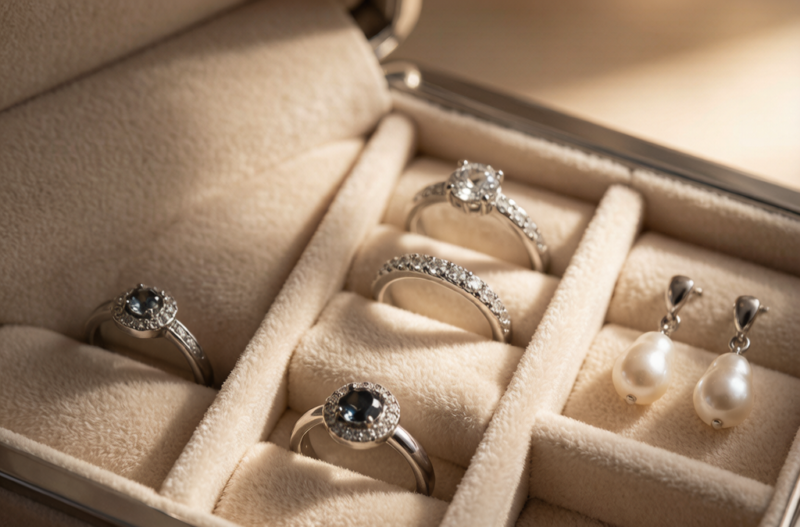
Velvet and flannel are the most common lining materials. Soft to the touch, they won’t scratch delicate surfaces, making them ideal for storing diamonds and gemstones. Necklaces laid flat on velvet won’t slide around, sparing you the nightmare of untangling chains.
[Image: Velvet lining close-up]
Velvet lining — soft to the touch, gentle on every piece
Genuine Leather — Where Texture Meets Protection
A PU or genuine leather exterior paired with a fabric interior is the standard for mid-to-high-end jewelry boxes. Leather is dust-resistant, moisture-proof, and has a satisfying weight. Placed on a vanity, it doubles as a decorative piece in its own right.
Wooden Base — Steady and Sophisticated
Solid woods like walnut and beech are perfect for storing luxury watches and heavier brooches. Wood is dimensionally stable, unaffected by temperature fluctuations, and won’t warp over time.
How to choose? For everyday lightweight pieces, a velvet-lined box is plenty. For multiple valuable items, go with a leather-and-velvet combo. Watch collectors should prioritize wooden options.
02
Craftsmanship: The Devil Is in the Details
Whether a jewelry box is worth buying reveals itself in a few telling details.
Hinges and Closure
A quality box opens and closes smoothly, with no creaking hinges. Lift-off lid boxes (two-piece design) rely on the box’s own weight for a snug, airtight closure. Hinged flip-top boxes are convenient but require attention to hinge durability over time.
Lining Precision
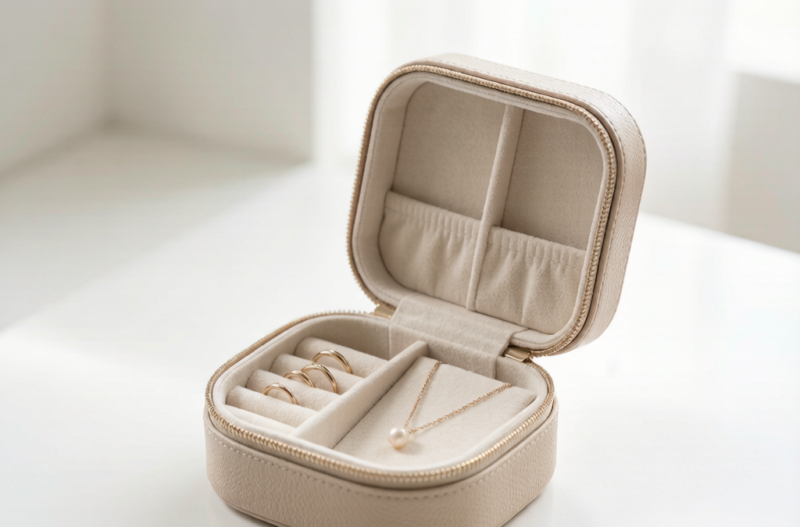
The interior fabric should lie flat — no wrinkles, no frayed edges. Compartment dividers should be clean-cut with no glue seepage. These details determine whether your jewelry is “protected” or “scratched” the moment it goes in.
Compartment Layout
Ring slots, earring holes, necklace hooks, bracelet sections — a well-designed box features functional zoning so you know exactly where everything belongs. Open a thoughtfully organized box and you’re greeted by a tidy, orderly display.
Exterior Finish
For leather, check whether the stitching is even. For wood, check whether the surface is smoothly sanded with no splinters. Decorative techniques like foil stamping and embossing add elegance when done well, but look cheap when done poorly.
03
Scenarios: Beyond the Vanity Table
The Three Minutes Before You Head Out
A medium-sized box on your vanity, opened each morning — earrings, necklace, and ring each in their designated spot. Three minutes to put together today’s accessories, no rummaging through a cluttered tray. This is the most everyday scenario: helping you move fast and stay composed.
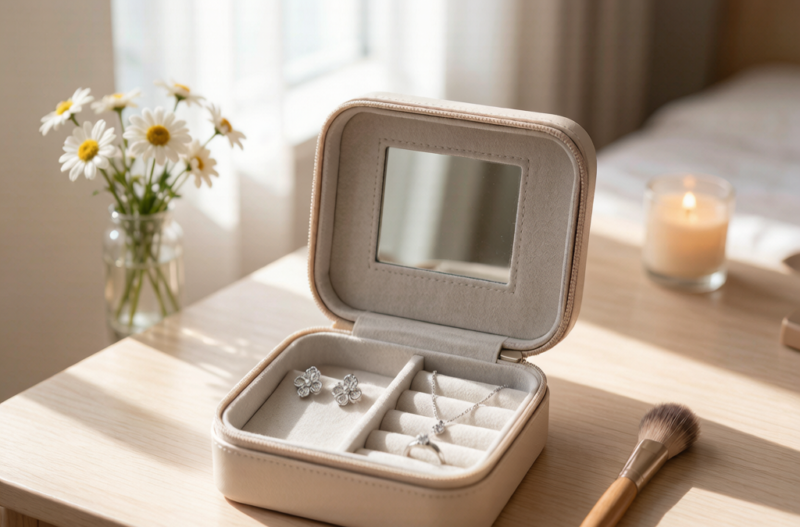
Three minutes each morning — everything at a glance
Travel and Business Trips
A compact, portable jewelry box with individual slots and cushioned lining. Pack a few frequently worn pieces, tuck it into your suitcase — no crushing, no losing. Open it at the hotel, and everything is right where you left it.
Gifting and Collecting
A beautiful jewelry box is a gift in itself. A leather box presented on a birthday or anniversary, a ring nestled inside — the moment it opens, the sense of occasion is complete. For collectors, a good box protects not just the value of the jewelry, but the story behind each piece.
Retail and Display
For jewelry retailers, display boxes demand a higher standard. Transparent acrylic lids, velvet-lined bases, coordinated lighting — every element works together to present each piece at its best. A quality display box directly shapes the customer’s first impression.
04
Three Principles for Choosing
After all that, it really comes down to three sentences:
Five pieces or fewer — go compact and portable. Around ten — a medium desktop box. Twenty or more — consider a large multi-tier box or spread across several organizers.
Lots of necklaces? Choose one with hooks. Mostly rings? Look for slotted cushions. Earring-heavy? Prioritize boxes with earring holes. Don’t buy a beautiful box with the wrong layout.
Long-term vanity display — leather or wood, textured and stain-resistant. On the go — lightweight velvet or fabric. As a gift — choose an elegantly packaged presentation box.
The right fit is always the best fit.
A jewelry box isn’t really about buying a “box.” It’s about finding a proper place for every piece you own. A good one makes you feel at ease each time you open it — everything easy to find, beautifully arranged, and safely stored when closed.
