

Maximum Organization: The Five-Layer Drawer-Type Jewelry Box by JMZ When a jewelry collection demands serious…
Great Packaging Speaks — Slide Drawer Box
Get the packaging right, and the product instantly doubles its perceived value. That’s not a bold claim — it’s just how buyers think.
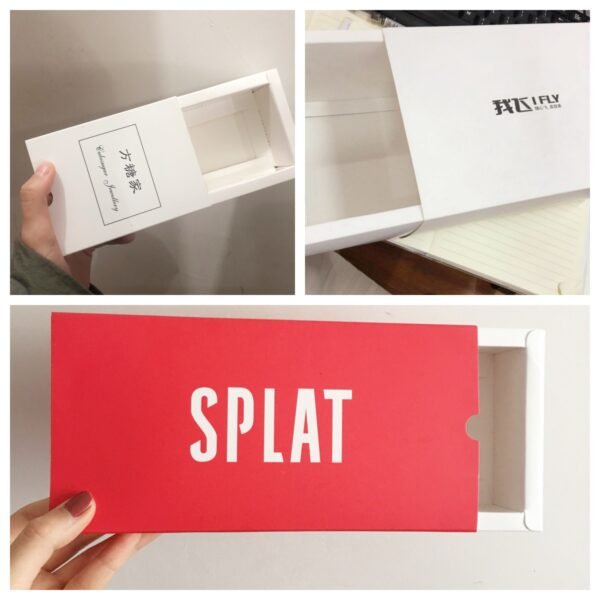
Picture this: two products of roughly equal quality sit before you. One comes in a flimsy plastic shell. The other slides smoothly out of a beautifully crafted drawer box. Which one are you willing to pay 30% more for? You didn’t need to think about that answer. The slide drawer box is the container that lets the product introduce itself. The matte white edition — restrained and minimal. The bold red edition — striking and confident. The clear-window edition — teasing just enough to spark curiosity. This isn’t just packaging. It’s the product’s opening line.
01
Materials & Grammage: the backbone that holds its ground
Materials & Grammage: the backbone that holds its ground
A drawer box looks simple — an outer sleeve housing an inner tray. But its dependence on material quality is absolute. If the materials fail, the entire experience collapses.
The Outer Sleeve — greyboard wrapped in coated paper. Stiffness is non-negotiable. The outer shell uses greyboard (chipboard) as its skeletal frame, typically 1.5–2.0 mm thick, laminated with 157 gsm or 200 gsm coated art paper. The combination sounds straightforward, but the density and rigidity of the greyboard are what determine whether the box has backbone. Low-density greyboard delaminates over time, with edges that fray and fuzz — the loose, sloppy feel when you pull the drawer open gives it away instantly. High-grade greyboard sits at around 0.6–0.7 g/cm³ density. Pick it up and you feel the weight immediately.
The Inner Tray — greyboard wrapped in white card or specialty paper. The drawer tray uses the same greyboard skeleton, laminated with 200–250 gsm white card or textured specialty paper. This grammage ensures the tray has enough structural rigidity — it won’t twist or warp when pulled out. For the clear-window variant, the window is covered with 0.3–0.5 mm PVC or PET film, crystal-clear and resistant to yellowing over time.
Surface finishing is the finishing touch. White editions typically go with a matte lamination — warm to the touch, fingerprint-proof, crisp and clean. Red editions often feature spot UV or foil stamping (gold/silver), giving the brand lettering a dimensional, glossy lift. Lamination also has a hidden benefit: once laminated, the surface hardness jumps significantly — scratch resistance improves by an order of magnitude over bare paper.
Outer Shell
1.5–2.0 mm greyboard · 157 gsm+ coated paper
Inner Tray
Greyboard frame · 200–250 gsm white card
Surface Finish
Matte lamination / spot UV / foil stamping
Window Material
0.3–0.5 mm PVC / PET high-clarity film
02
Craftsmanship: four stages, each one critical
Craftsmanship: four stages, each one critical
Making a drawer box isn’t just “cut some boards and glue them together.” It’s a precision multi-stage workflow — a tiny deviation at any single step gets amplified into an obvious flaw by the time the box reaches your hands.
Die-Cutting
Greyboard + face paper cut and scored, V-groove creasing in one pass
Mounting
Face paper precision-laminated to greyboard, bubble-free, no edge lift
Finishing
Lamination / foil stamping / UV — multiple layers, zero registration shift
Assembly & QC
Tray-to-sleeve fit tested, sliding resistance checked for every unit
Die-cutting is the soul of the box. A drawer box isn’t a straight-edged square — the outer sleeve and inner tray need a precise clearance gap, typically 1–1.5 mm. Too loose, and the drawer wobbles. Too tight, and you’ll struggle to open it — or worse, it seizes up entirely. A high-quality drawer box glides with a “smooth but damped” feel. That comes from greyboard thickness tolerance held to ±0.1 mm and V-groove scoring depth dialed in without the slightest error.
Mounting tests patience. Laminating face paper onto greyboard demands zero bubbles, zero wrinkles, and edges that bond firmly without lifting. Adhesive choice is critical — white PVA glue cures to a balanced hardness that won’t make the paper brittle; hot-melt glue is used for rapid tack positioning. With skilled hand-mounting, you won’t see a single gap between the face paper and the greyboard — as if they were born as one.
Surface finishing defines the tier. Brand lettering on the white edition needs to print sharply on heavyweight coated paper — crisp edges, no under-inking, no fuzziness. The red edition demands bold, even full-coverage color with zero patchiness or shade discrepancy. Boxes with foil stamping require the metallic foil to lay flat and bright — the high-temperature embossing must never burn through the paper beneath.
“It takes you a single second to pull open a drawer box. But that one second of smoothness and solidity is held up by over a dozen processes, done right.”
03
Hardness & Durability: a thousand slides, still like day one
Hardness & Durability: a thousand slides, still like day one
Talking about a box’s “hardness” might sound odd — it’s not a tool, after all. But the packaging you’re buying isn’t meant to be used once and tossed.
Ring crush strength of the greyboard is the key metric. At 1.5–2.0 mm thickness, greyboard typically delivers a ring crush index of 6.0–8.0 N·m/g. In plain language: press your palm down on the box surface and you won’t create a visible dent. Stack three filled drawer boxes on top of each other and the bottom one stays undeformed — that’s real protection for warehousing and shipping logistics.
Abrasion resistance of the lamination layer matters just as much. A matte-laminated box surface won’t show scratches from a normal fingernail swipe. On bare paper, a few rounds of sliding the drawer in and out would have already worn the edges white. Lamination is like an invisible tempered film over the box — it protects the printed artwork and dramatically extends the visual lifespan.
Drawer rail endurance is the ultimate test. A well-designed drawer box accounts for “friction fatigue” — the outer walls of the inner tray repeatedly rub against the inner walls of the outer sleeve. If the greyboard density is insufficient or the surface treatment is neglected, powdering and fraying set in after just a few dozen cycles. A quality drawer box, by contrast, can withstand 500+ normal open-close cycles without visible wear. In this product category, “slides as smoothly as the first day” is the highest praise you can give.
In one sentence: a box that makes you want to open and close it again and again doesn’t get there by luck. It’s the sum of material hardness and machining precision, both done right.
04
Scenes: every industry is missing “the right box”
Scenes: every industry is missing “the right box”
The beauty of the slide drawer box is that it doesn’t play favorites with industries — almost any product that benefits from a sense of occasion gets a boost from it. Here are six real-world scenarios. See if your product falls along one of these lines.
💍
Jewelry
Rings, bracelets, necklaces — jewelry inherently deserves to feel treasured. Sliding it out of a drawer box carries far more ceremony than flipping open a lid.
🧴
Skincare & Beauty
Serums, creams, fragrances — a drawer box with foil-stamped branding makes the ingredient-conscious buyer think: this brand is serious about what they do.
🎧
Tech Accessories
Earbuds, cables, power banks — small items stored in a drawer box look tidy and elevated. Windowed versions let customers see the product upfront, reducing “wrong color” returns.
🎁
Gifting & Festive Sets
Holiday gifting — customize a drawer box with internal compartments for assorted items. The moment the recipient slides it open is a ready-made shareable moment.
📚
Stationery & Lifestyle
Fountain pens, wax seals, washi tape — drawer boxes carry a “curated stationery shop” vibe. Placed in a bookstore or design store, it becomes a display piece worth photographing.
👔
Luxury Accessories
Cufflinks, tie bars, brooches — small, refined accessories are a natural fit for drawer boxes. Whether matte white or matte black, either finish lifts the product’s perceived tier by a full notch.
You’ll notice a pattern across all six scenes: the product itself is “not large,” but it “deserves to be taken seriously.” Drawer boxes are a natural match for small, beautiful goods — the box isn’t big, but every inch of it speaks on the product’s behalf. And the three core styles — matte white for minimal restraint, bold red for instant visual impact, windowed for a “half-reveal” tease of curiosity — your product probably leans toward one of them. Which one fits best?
