

Wood & Leather Display Boxes: Timeless Packaging for Premium Jewelry When your jewelry deserves presentation…
The Complete Guide to Mailer Boxes
What Is a Mailer Box?
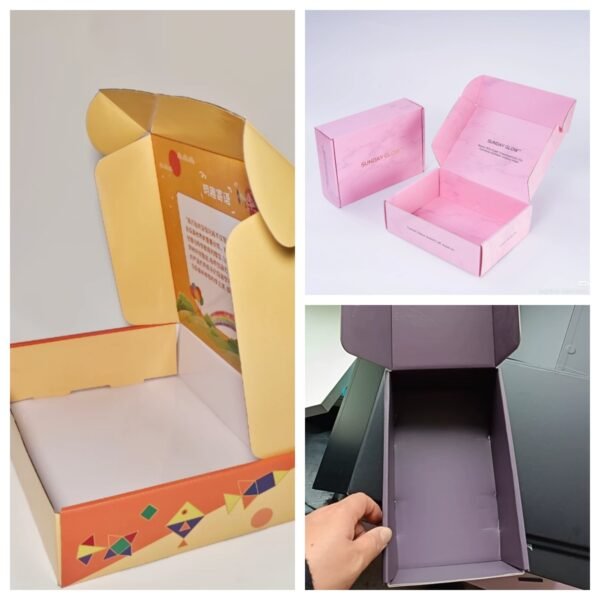
A mailer box, technically known as a “special-shaped opening corrugated box,” gets its name from its unfolded shape, which resembles the top-down silhouette of an airplane. Its biggest advantage is one-piece forming with no tape required — simply fold and tuck to seal, dramatically improving packing efficiency. It is the go-to packaging choice for e-commerce, apparel, 3C accessories, and lightweight goods.
1. Common Size Specifications
Mailer boxes are categorized by inner dimensions (L×W×H, in mm) into standard and custom types:
| Size Model | Inner Dimensions (mm) | Suitable Products |
|---|---|---|
| XS | 100×70×50 | Jewelry, digital accessories |
| S | 170×120×60 | Phone cases, cosmetics |
| M | 250×170×90 | Folded apparel, books |
| L | 350×250×120 | Shoes, multi-item sets |
| XL | 450×300×150 | Heavy clothing, assorted goods |
Sizing Tip: Inner dimensions = product size + 10–15mm clearance on all sides. Better slightly loose than too tight — avoid product damage or box deformation.
2. Material Selection
The material directly determines load-bearing capacity, moisture resistance, and cost. The main options are:
1. B-Flute Corrugated Board (3mm thick)
- Lightweight and sturdy, the most commonly used spec
- Suitable for lightweight items under 1 kg
- Low cost, good print reproduction
2. E-Flute Corrugated Board (1.5mm thick)
- Thinner and smoother than B-flute, closer to rigid cardboard feel
- Suitable for premium packaging and gift boxes
- Higher print precision, ideal for full-color graphics
3. B+E Double-Wall (approx. 4.5mm)
- Dual-layer composite, significantly stronger
- Suitable for products weighing 2–5 kg
- Commonly used for 3C electronics, wine, precision instruments
4. Multi-Layer Combinations (3-ply / 5-ply)
- 5-ply corrugated (AA/AB/BB flute) for heavy-duty cargo
- Mostly used for industrial goods and bulk e-commerce distribution
Material Recommendation: Standard apparel/lightweight items → B-flute; Premium brands → E-flute; Heavy goods → B+E or 5-ply.
3. Board Grammage
Grammage determines paper thickness and strength. Common specs:
| Paper Layer | Common Grammage | Notes |
|---|---|---|
| Liner (outer) | 100g / 120g / 150g | Higher grammage = clearer printing |
| Fluting (middle) | 80g / 100g | Affects cushioning performance |
| Liner (inner) | 100g / 120g | Affects overall rigidity |
Premium Brand Tip: Use 150g white kraft liner on the outer layer with E-flute composite for a noticeable quality upgrade.
4. Common Finishing Processes
| Process | Effect | Best For |
|---|---|---|
| Matte Lamination | Soft matte finish, water- and scratch-resistant | Premium brand boxes, gift boxes |
| Gloss Lamination | Shiny reflective surface, vibrant colors | Food, e-commerce promotional items |
| UV Spot Coating | Localized high-gloss or raised effect | Logos, key design elements |
| Gold/Silver Foil Stamping | Metallic sheen, strong premium feel | Brand names, icons |
| Embossing | Raised or recessed surface texture | Leather-grain or fabric-texture effects |
| Die-Cutting | Precision irregular cutting | Key process for mailer box forming |
Best Value Combo: Matte lamination + spot UV — controllable cost with rich visual layers, the mainstream choice for branded e-commerce.
5. Printing Methods
Flexographic Printing (Water-based Ink)
- Low cost, ideal for high-volume single-color or simple printing
- Limited color vibrancy, slightly lower precision
- Best for: Standard shipping boxes, warehouse transit boxes
Offset Printing
- High precision, excellent color reproduction
- Suitable for complex patterns and full-color brand packaging
- Minimum order quantity typically 500 pcs
Digital Printing
- No minimum order limit, top choice for small-batch customization
- Higher cost, ideal for sampling or special editions under 50 pcs
- Color performance close to offset printing
Mass production → offset; sampling/small batches → digital. For color-sensitive brands, request a proof to confirm color accuracy before mass production.
6. 5 Questions to Confirm Before Ordering
- Inner or outer dimensions? Always specify when providing sizes to the manufacturer to avoid errors.
- What is the product weight? Determines material selection — heavy items need double-wall or 5-ply.
- Is printing required? Printing determines the finishing direction and affects pricing.
- What is the quantity? Directly affects unit price — 500+ pcs makes offset more cost-effective.
- Are special slots or windows needed? Some products require custom die-cutting — inform us in advance.
Related products
