

PVC Clear Inner Bag — A Complete Product Guide Sizes · Materials · Manufacturing Process…
-
0 Comments
You’ll Know It the Moment You Touch It
Product Series · Part Ⅰ of Ⅲ
Anna B Floral Binder · A Three-Part Series
You’ll Know It the Moment You Touch It
Material · Craft · Durability — Everything Starts with Feel
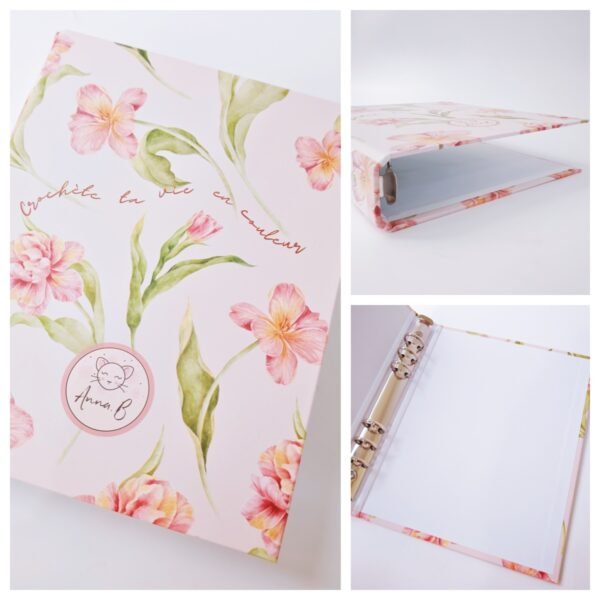
● Part One · Material & Craft →
○ Part Two · Scene & Lifestyle →
○ Part Three · Design & Aesthetics
The Moment Your Fingertips Meet the Cover
There are thousands of binders on the market, but very few brands actually care about what goes into them. The Anna B Floral Binder starts talking to you through its details the moment you pick it up.
Have you ever walked into a stationery store, picked up a binder, flipped through it twice and put it back down? Paper too thin, rings too loose, cover that collapses the second you squeeze it. That “good enough, I guess” feeling is the impression most binders leave. Not unusable — just completely joyless to use.
The Anna B Floral Binder is different. Not in a way you’d notice at a glance on a shelf — but in a way that slowly reveals itself as you hold it, flip through the pages, open and close it a few times. A quiet feeling builds: someone actually put thought into this.
In this first piece, we’ll start with the basics: materials, construction, and durability. No talk of design or lifestyle just yet — just one honest question: is this thing well-made?
The Cover: 2mm of Rigidity That Actually Means Something
Let’s start with the cover. When most people pick a binder, they look at the pattern — but they miss the one spec that determines whether it will actually stand up: the thickness and stiffness of the cover board.
Anna B uses high-density greyboard as the core substrate, approximately 2mm thick. For context, most standard binder covers run between 0.8mm and 1.2mm — flimsy enough that they bow and buckle once you load in a few dozen sheets. What does a 2mm cover actually give you?
- ◆Stands upright: Fully loaded and placed on a shelf, the cover holds its shape — no slouching, no warping
- ◆Survives the bag: Packed alongside books, a laptop, and everything else, it comes out of your bag looking exactly the same
- ◆Self-supporting for writing: You can write directly on it without needing a desk beneath — the cover provides its own resistance
- ◆Resists creasing: Higher-density board fibers mean daily handling won’t leave permanent impressions or fold marks
But the substrate is only part of the story. Over the board sits a layer of PVC matte lamination. This isn’t just about making the floral print look better — it delivers a genuine triple protection: scratch-resistance, water-resistance, and stain-resistance.
Think about how binders actually get used: a splash of coffee, a pen accidentally dragged across the cover, months of oils and residue from your hands. Without lamination, the cover degrades fast. With this PVC layer, none of that sticks — a damp cloth handles spills, moisture wipes away clean, and three months of daily use later, it still looks brand new.
✦ Cover Material Specs
Core substrate: High-density greyboard, 2.0mm ± 0.1mm thickness
Lamination: PVC matte film, 0.08mm, anti-scratch surface treatment
Printing: Multi-layer watercolor-effect color printing, color fidelity ≥ 95%
Hardness: Shore hardness approx. 85HD — resists deformation under everyday flexing
Inner Pages: Paper Above 100gsm — Serious Writing Deserves It
Now for the inner pages. This is the part most people completely ignore when buying a binder — who checks paper weight at the point of purchase? But once you’re using it day after day, paper quality becomes the single biggest determinant of the experience.
Anna B uses inner pages ranging from 100gsm to 120gsm. If those numbers don’t mean much yet, here’s a practical reference:
- ◆70gsm: Standard in budget binders — thin, translucent, ink bleeds through from fountain pens, visible on the reverse
- ◆80gsm: Ordinary copy paper — workable for office printing, but too thin for note-taking you’ll want to keep
- ◆100gsm: Enters “comfortable writing” territory — fountain pens glide cleanly, highlighters don’t bleed through to the back
- ◆120gsm: Close to business card stock — zero show-through on both sides, ideal for archival documents
So Anna B’s choice of 100gsm+ isn’t arbitrary. This range hits the sweet spot: great writing experience without the binder becoming unwieldy. Go any thicker and capacity suffers; go thinner and the writing experience degrades noticeably. 100–120gsm is a well-proven equilibrium.
There’s one more subtle detail: a micro-coating on the paper surface. Invisible to the eye, but unmistakable under a pen tip — the resistance is calibrated just right: not so smooth that your writing skates, not so rough that the nib catches. For fountain pen users in particular, this tactile feedback is a meaningful difference.
Then there’s hole-punch precision. Six-ring binders depend on exact hole spacing — even a fraction of a millimeter off and pages sit crooked or jam during turning. Anna B holds tolerance to within ±0.3mm across all holes. The result: every page seats perfectly in the rings, and turning is frictionless.
Paper weight isn’t a luxury.
It’s the minimum respect
owed to the act of writing.
— On paper weight
The Rings: Zinc-Alloy D-Rings — The Underrated Core Component
If the cover is the face and the pages are the content, the rings are the skeleton connecting them. Ring quality accounts for at least half of a binder’s real-world usability — and it’s what most brands cut corners on.
Anna B uses six-hole D-rings in zinc alloy. Two key terms worth unpacking.
1Zinc alloy vs. standard iron
Budget binders almost universally use iron rings. Cheap to produce, but the tradeoffs are real: iron rusts, deforms, and loosens over repeated use. Zinc alloy is different — significantly harder (Brinell hardness ~70–80HB versus iron’s ~40–50HB), corrosion-resistant, and structurally stable over years of use. Yes, it costs more. But this is precisely the component that warrants investment.
2D-rings vs. O-rings
O-rings are the most common ring type — circular, simple, familiar. They also have a fundamental flaw: all page pressure concentrates at the top of the circle, causing crowding and resistance when the binder is full. D-rings flatten one side of the circle, allowing pages to lie flat and fan freely. Turning pages feels nearly frictionless. D-rings also hold 20–30% more capacity than O-rings of equivalent size.
✦ Ring Mechanism Specifications
Material: Zinc alloy (Zn-Al-Cu series), electroplated anti-rust surface
Structure: Six-hole D-ring, standard 80mm spacing (compatible with A4/A5 universal refills)
Hardness: Brinell 70–80HB — deformation-resistant under normal load
Cycle test: Tested through 2,000+ open/close cycles — no sticking, no loosening
Load capacity: Handles approximately 120 sheets of A4 (100gsm) without strain
One more detail worth noting: the closure mechanism itself. On cheap binders, the release lever is stiff and sticky — every opening requires fingernail force. Anna B’s mechanism uses an optimised lever geometry: light pressure opens it cleanly, and it clicks shut with a satisfying snap. Once you’ve experienced a well-engineered closure, going back to a stiff one feels like a small punishment.
Binding & Overall Structure: No Shortcuts Where You Can’t See
Beyond the three core components, a few “invisible details” are worth mentioning.
Start with the spine-to-cover hinge. On many binders, this joint cracks within months — the result of inadequate reinforcement at the flex point. Anna B adds a double-layer reinforcement here: an inner canvas hinge strip bonded beneath the lamination. Repeated daily opening won’t cause delamination or splitting.
Then there’s spine width. Anna B’s spine is approximately 25mm — wide enough for around 120 A4 sheets. This isn’t an arbitrary number. Too narrow and capacity suffers; too wide and the binder becomes bulky and awkward to carry. 25mm is a measured balance.
Finally, rounded corners. The four corners aren’t cut at right angles — they’re R5 radius rounds. Small detail, real benefit: rounded corners resist dog-earing and don’t snag other items in your bag. Products that care about the experience find a way to address the small things.
- ◆Reinforced hinge: Double-layer canvas + lamination — fatigue-resistant through daily flex cycles
- ◆Rounded corners: R5 radius — resists folding, smooth against other contents in your bag
- ◆Spine width: 25mm standard — balanced between capacity and portability
- ◆Overall weight: ~280g empty, ~520g with 120 sheets — comfortable to hold in one hand
Good materials don’t announce themselves.
But your hands
always reach their own verdict.
— On material quality
In Summary: Genuine Quality Is Hard to Hide
Everything from cover to inner pages, from ring mechanism to binding structure — Anna B’s material choices sit at or above the ceiling for this price point. 2mm greyboard, PVC matte lamination, 100gsm+ paper, zinc-alloy D-rings, 2,000-cycle tested closure — each spec individually seems unremarkable. Together, in your hands, the difference becomes impossible to ignore.
A good tool shouldn’t ask you to tolerate it. It should feel comfortable to use, reliable to depend on, and built to last. From a materials and construction standpoint, Anna B has delivered something genuinely solid.
But materials are only the foundation. A product with good materials still needs to earn its place in your actual life — to prove itself useful in the real moments you reach for it. In the next piece, we’ll shift perspective and explore exactly that: which scenes call for this binder, and how it fits into the rhythms of everyday life.
— End of Part One · Up Next: Scene & Lifestyle —
Related Posts
- PVC Clear Inner Bag — A Complete Product Guide
- Curtain Fabric Sample Binder — Professional · Customizable · Premium
Curtain Fabric Sample Binder Premium · Customizable · Professional Presentation A curtain fabric sample…
- How to Choose the Right Curtain Fabric Sample Binder — A Practical Guide
===== Header ===== Buyer's Guide How to Choose the RightCurtain Fabric Sample Binder A practical,…
