

Focus Keywords: transparent A4 plastic file box, PP injection molded document storage, plastic file organizer with lid, office document storage manufacturing, dustproof file container production Aliases: • Clear A4 Document Storage Box | Transparent Plastic File Organizer • PP Injection Molded File Box with Handle | Office Document Case • A4 File Storage Container with Lid | Dustproof Document Holder • Desktop File Organizer | Transparent Archive Box • Stackable Document Storage | Plastic File Container Description: Learn the complete manufacturing process of transparent A4 plastic file storage boxes. From material selection (PP/PET/PS/PVC) and injection molding to quality control and supplier evaluation. Includes production parameters, defect prevention, and inspection standards for reliable document storage solutions. ——————————————————————————————————————————————————————— Understanding Transparent A4 Plastic File Box Manufacturing: Material Selection, Production Process, and Quality Assurance Guide Transparent A4 plastic file storage boxes with lids and handles serve as essential tools for office document organization, school material management, and household paperwork storage, available in two primary specifications: the spacious red variant measuring 36 by 27 by 4.5 centimeters for relaxed A4 document accommodation, and the compact blue version at 31 by 23 by 4.5 centimeters for space-efficient desktop arrangements. The manufacturing journey commences with critical material selection, where polypropylene dominates the market due to its exceptional toughness, cost efficiency, and recyclability, while polyethylene terephthalate caters to premium segments with superior optical clarity despite increased brittleness risks. Polystyrene and polyvinyl chloride alternatives exist but carry significant limitations in durability and environmental compliance respectively. The production process initiates with precision steel injection mold development requiring mirror-polished cavity surfaces achieving roughness values below 0.05 micrometers to ensure optical transparency, with tooling investments ranging fifteen thousand to forty thousand Chinese yuan and lead times spanning fifteen to thirty days inclusive of sampling and refinement cycles. The injection molding stage operates through horizontal machines with clamping forces between 160 and 300 tons, where polypropylene processes at 200 to 250 degrees Celsius and polyethylene terephthalate requires 260 to 280 degrees Celsius, with raw materials demanding pre-drying at 80 to 100 degrees Celsius for two to four hours to eliminate moisture that would otherwise cause silver streaking and bubble formation. Mold temperatures must maintain 60 to 80 degrees Celsius to prevent surface flow marks and opacity issues, while cycle times average 25 to 45 seconds per shot with normal production achieving 95 to 98 percent yield rates. Quality…
On Transparent Book Covers
On Transparent Book Covers
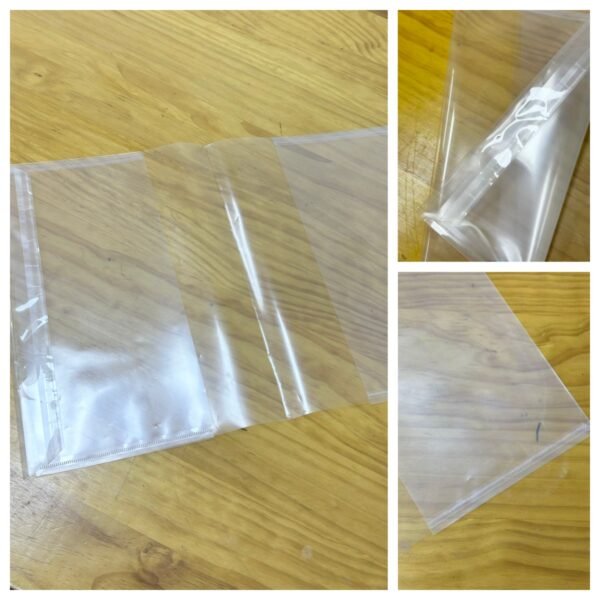
What You Open Is Not a Book, But Time Itself
The moment a book is unwrapped, it begins a long negotiation with air, light, fingerprints, and coffee stains. Dog-eared covers, faded spines, yellowed pages — these are evidence of a book being read. But they are not necessarily everything it deserves to endure.
Some see a book cover as respect for the book. Others, as unnecessary fuss. Neither argument matters. What matters is how the book looks when you close it — the way you want to remember it.
Not All Plastics Are Created Equal
The most common question is “which one is best.” But before asking “which,” ask “what’s available.” Transparent book covers on the market boil down to three materials in various combinations.
Polypropylene
The most common. ~85% clarity, soft feel, good flexibility. Ranges from 0.08 mm to 0.18 mm. Affordable and widely available — the first type most people encounter.
Polyethylene Terephthalate
Clarity above 92%, more rigid, with a feel close to glassine. 0.12 mm to 0.2 mm. Scratch-resistant, warp-resistant, won’t yellow over time. Typically 2–4× the price of PP.
As for PVC — cheap, yes, but it yellows, smells, and can even stick to your book cover over time. Unless you need a temporary dust shield, it doesn’t qualify as “decent” by any measure.
The Craft Lives Where You’re Not Looking
Thickness is only the coarsest measure. What truly determines whether a book cover feels good to use: how clean the edges are cut, how well the corners fit, and — once it’s on — whether it “disappears.”
Edge Cut
Heat-cut edges are smooth; cold-cut edges can be rough. This is the single biggest perceptual difference between the cheap and the decent.
Sealing Method
Ultrasonic sealing beats heat-press. More uniform, more durable, edges won’t lift. PET covers above the mid-range price point tend to use this process.
Clarity Level
Clearer isn’t always better. High-clarity PET is nearly invisible but picks up fingerprints. Micro-matte PET finds the sweet spot between transparency and smudge resistance.
Dimensional Precision
A good A4 cover is slightly larger than A4 (about 212 × 299 mm, not exactly 210 × 297 mm). That extra margin lets the jacket breathe — snug, not tight.
Where “Good Enough” Meets the Curve
For most people, a PET book cover in the mid-range marks the boundary between “worth buying” and “paying too much.”
This isn’t an arbitrary number. Breaking down the cost: 0.15 mm PET raw material runs about $0.20–0.28 per sheet; ultrasonic sealing and precision die-cutting add $0.14–0.21; packaging and distribution push it to the retail price you see. Beyond that threshold, you’re no longer paying for “protecting a book” — you’re paying for something that has little to do with the cover itself.
Entry Level
0.08–0.12 mm PP
Functional. Keeps covers from scuffs and dust. For high-volume use: textbooks, workbooks, frequently handled references. Nothing fancy, but it does the job.
Sweet Spot
0.12–0.18 mm PET
This is the range worth talking about. PET beats PP on clarity, rigidity, and durability across the board — and the price won’t make you pause. Use it for three years, and it costs less than a cent per day. It’s not “expensive” — it’s just hard to go back once you’ve tried it.
The best book cover is the one you forget.
Open the book and your fingers meet the smooth, warm jacket — not a plastic film. Close it and it rests by your hand, never stealing the book’s texture, never leaving the book alone against time. This is the only reason book covers exist at all.
